
...
| Expand | ||
|---|---|---|
| ||
Why? "Bad things can happen to good science" (1), and while you may not think of it at first, the data, ways of working, and collections created in your collaboration are valuable and deserve protection. External cybersecurity attacks of course come to mind, but in many cases inadvertent accidents happen and are at least as big a risk. Identifying your 'primary assets' (or the 'crown jewels' of the collaboration) helps you to identify where you need extra protections, and how to prevent deletion, changes, or loss of data ... and people. There may also be legal and regulatory reasons to apply controls through your AAI. They can be in the research data itself, like medical and patient data, dual-use goods and knowledge, commercially confidential data, or ethical reasons on human research or in the Nagoya Protocol. Recommendation:
Applicable guidance: REFEDS Data Protection Code of Conduct, (1) Open Science Cyber Risk Profile (Sean Peisert et al, TrustedCI), ITSRM2 (risk management), Privacy Notices |
| Expand | ||
|---|---|---|
| ||
Why? This basic set of 6 documents helps get a sufficient set of collaboration guidelines quickly - you can always adapt them later Recommendation: these are the documents you surely need - or you need to ask from your AAI provider:
Applicable guidance: REFEDS privacy notice, UK-IRIS example privacy notice, EOSC, UK-IRIS security policies, AARC-I051 "federated incident response procedure" |
...
| Expand | ||
|---|---|---|
| ||
Why? You realise you need to enforce a policy only once things do not 'go as planned' - and having the discussion on acceptance at that point is rather late. And how can users, for instance, know what they are allowed to do with the research data, or when to ask for additional roles and group membership from membership management? Recommendation: the Policy Development Kit identifies five different 'audiences': governance, your users, the user home organisations and identity providers, the AAI management of the collaboration, and the infrastructures and service providers that control and host data, computing capacity, and the data transfer networks. Make sure all of then can access and understand your policies and processes, can work with you when you execute procedures for incident response, and engage with Sirtfi and security readiness exercises. Applicable guidance: AARC-G083 on notice management, WISE Baseline AUP and AARC-I044, Privacy Notices, REFEDS DP CoCo v2, membership managementMembership Management |
| Expand | ||
|---|---|---|
| ||
Why? Presenting policies and practices is one thing, but the AARC Blueprint Architecture also introduced a (chain of) AAI platforms or 'proxies' that augment, translate, or otherwise munge information about users and 'sources of authority'. Both for authentication sources and for service providers, it places intermediates in the chain of trust, and the longer the chain is, the more this trust will be diluted. Transparency through documentation can help retain that trust. And at the same time make it easier for the collaboration to engage with the users regarding the AAI. If identity is not bound to the user but to the user's home organisation (employer, university), the home organisation may be reluctant to make any claims for the authentication, even for trivial ones like name and email address (the 'personalised access' attributes that are foundational for research and scholarship). Or refuse to partake in authentication at all. Recommendation: publish your policies, but especially your contact information, in a place where users, relying parties, and home organisations can find it. If you chose a DNS-based community name, and you can resolve the domain name to point to a web site, that is a good place to present this information. And if confidentiality is needed, you may have your own AAI to help you! Applicable guidance: AARC-G071 (AAOPS), AARC-G083 on notice management, REFEDS Research and Scholarship, REFEDS Personalised Access, |
...
| Scroll ImageMap | ||||||||||||||||||||
|---|---|---|---|---|---|---|---|---|---|---|---|---|---|---|---|---|---|---|---|---|
|
Snctfi, operational policies, and AAI service providers
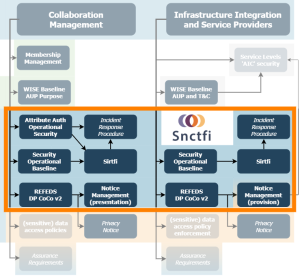 Smaller and mid-sized communities may opt to offload some of the more complex aspects of authentication and authorisation to dedicated AAI service providers. And if you operate your own AAI core components, both your users and resource providers may want to have some assurance about the trust and security posture of your AAI platform. The Snctfi suite is the set of assessable and verifiable policies and procedures in the PDK that AAI platform providers can use to make the trustworthiness of their systems transparent to users and relying parties alike.
...
Background to the Policy Development Kit
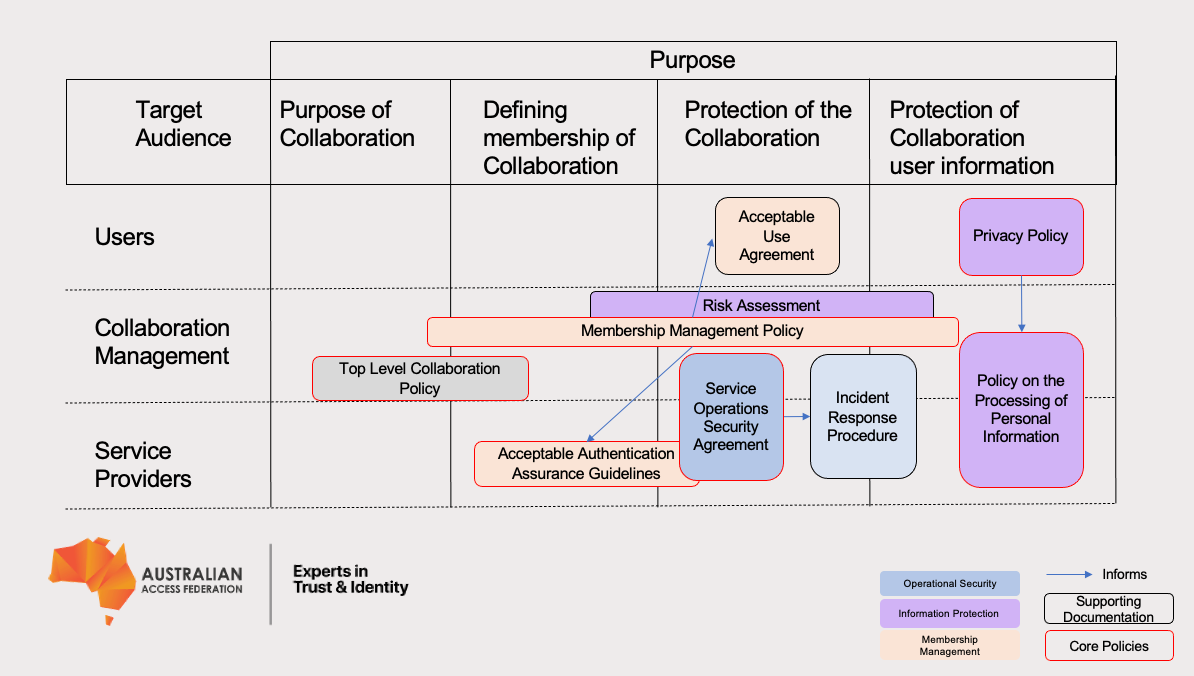 The first AARC Policy Development Kit, released in 2017, comprised a set of nine reference documents (mostly templates) addressing the construction and operation of community AAIs in the original AARC "2019" Blueprint Architecture, based on the Community First Approach. A mix of policies and procedures, its primary audience was primarily larger-scale research collaborations, expected to review, augment, and specialise the templates for their own use. With the policy development kit being created prior to or in parallel to other work in the community at large, it duplicated some aspects (privacy in REFEDS DPCoCo, or incident response work parallel to the eduGAIN Security Handbook), while being overly complex for smaller collaborations. Work by the Australian Access Federation, the AARC Community, and in REFEDS, WISE, IGTF, and the e-Infrastructures helped restructure the PDK into the v2 model presented above.
An analysis of the improvements required on PDK v1 is included in the informational document AARC-I082 "Trust framework for proxies and Snctfi research services" (doi:10.5281/zenodo.15506826)
...
This work and its supporting materials are licensed under a Creative Commons Attribution License (CC-BY) v4.0 unless otherwise specified.