Status Legend:
MISSING No information has yet been collected.
INCOMPLETE All information has not yet been collected.
COMPLETE Information collection has been completed.
FINALISED The template has been finalised.
Result information | |
|---|---|
| Title of the Result (120 characters) | AARC Recommendations for a common long-term AAI strategy |
Message/Teaser to the potential user (1000 characters) | What can Funding Agencies, Research Communities and AAI implementers and operators do to allow global connectivity between research infrastructures? Check out the AARC Compendium for concrete recommendations and guidelines |
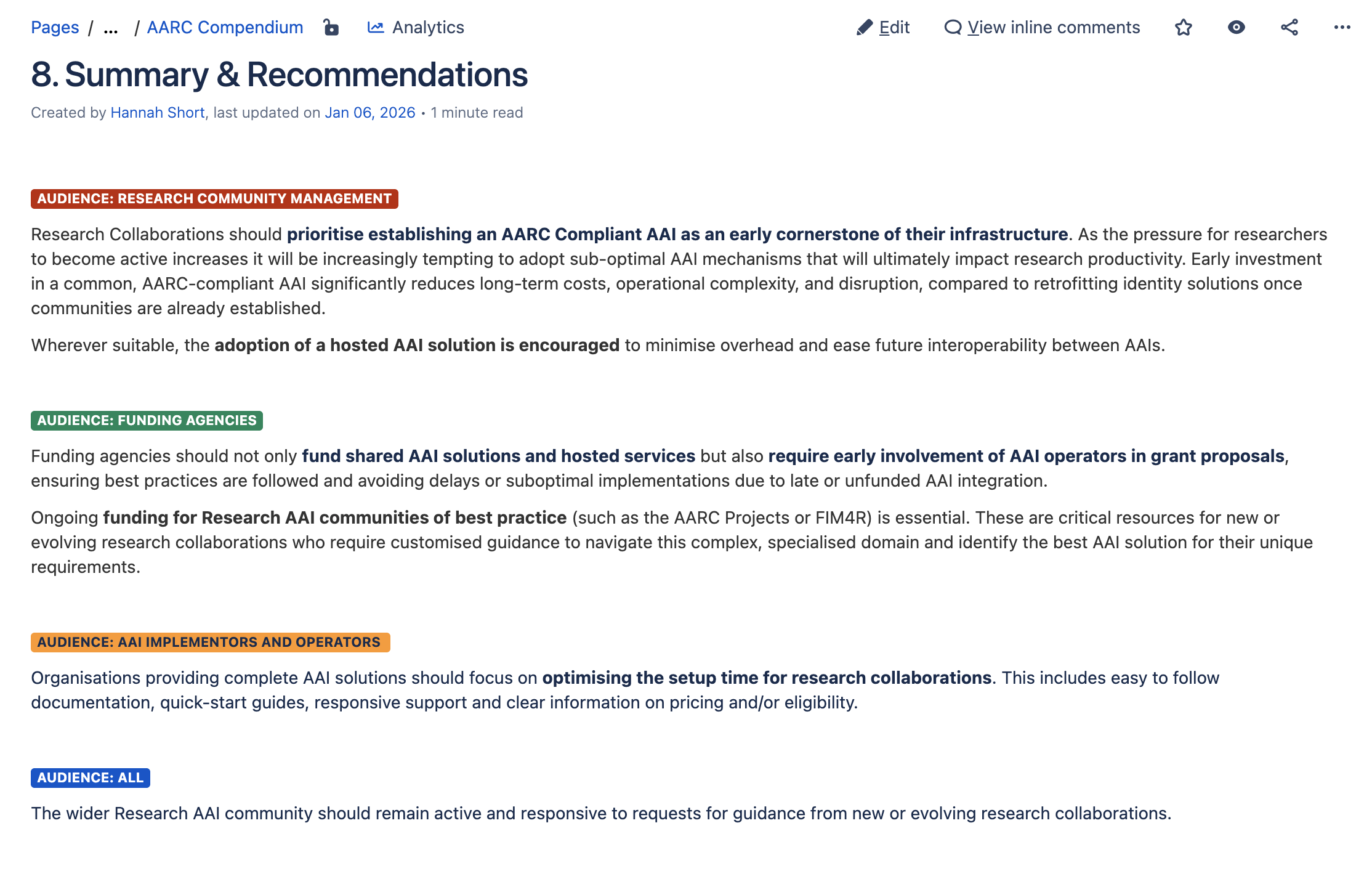
| Video/Image | https://wiki.geant.org/spaces/AARC/pages/1295024149/8.+Summary+Recommendations is a Wiki page of recommendations
|
Result Type |
|
Target Audience |
|
Our needs are |
|
We specifically need/are looking for (600 words) | The AARC TREE best practices and recommendations align technical approaches and foster collaboration in implementation across scientific domains. Via the AARC TREE Compendium, which will be published as the AARC Handbook, and the work carried out by WP3 work package, insight was gathered in terms of the current status of adoptions of the AARC guidelines including identifying challenges to their implementation and the need to have stable funding for the operations of AAIs in the R&E sector. The AARC Handbook, which has listed different recommendations aimed at different Target Groups, intends to function as an outreach and engagement tool, to support and foster further uptake of AARC guidelines by a wider group of research collaborations. |
About us | |
Main project | AARC-TREE project |
Other related projects | OSCARS: Open Science Clusters' Action for Research and Society |
Result Contributors | AARC-TREE Consortium |
Owners for exploitation | CERN, DARIAH, the AARC Handbook Editorial Board and the wider AARC Community |
Start-up created for further exploitation? |
|
Logo | N/A |
Testimonials | |
Title | The AARC Handbook, aimed at different Target Groups, intends to function as an outreach and engagement tool, to support and foster further uptake of AARC guidelines by a wider group of research collaborations. This work will continue beyond the end of the AARC-TREE project and will be coordinated by the AARC Handbook Editorial Board which will meet on a quarterly basis. More information will be collected in the coming months. The final version of the compendium, which has been renamed to handbook, was published on 25th February 2026. It will be promoted beyond the AARC TREE lifetime. |
Link | Testimonials, from research communities that use the AARC Handbook, will be collected on the AARC website over time: https://aarc-community.org/ |
Find us on | |
Description | The AARC Handbook will be published on Zenodo and available also on the AARC Website. |
Link | |
Result description and influence | |
Result description (1200 characters) | The Authentication and Authorisation for Research and Collaboration (AARC) Compendium - which will be published as the AARC Handbook - is intended as an introductory guide to implementing federated identity management for research collaborations, based on the AARC Blueprint Architecture (AARC BPA). This guide provides an introduction to Authentication and Authorisation Infrastructure (AAI). A glossary of key terms and their definitions is provided, as well as a list of Frequently Asked Questions (FAQs). The compendium covers a number of different topics, including: what is the AARC Blueprint and why has it been developed?, how to implement an AAI service outlining a number of implementation scenarios. An overview of the landscape of existing AAI solutions is provided including commonly used software and services as well as hosted services. Specific topics such as technical requirements, security, data protection and policy related issues are covered, including how to build the necessary bridges between legal, policy and technology. The AARC Handbook has been written with several audiences in mind:
|
Business Sector(s)/Policy Area(s) |
|
Tags/Keywords | Recommend that you use keywords to describe the technology, science, sector, content or nature of the result and very importantly, keywords to denote potential uses or applications of your result. Please note that, by default, you will see in your submission form all keywords linked to the main project you had chosen for declaring this result. This is to help you get started. Feel free to remove those keywords irrelevant to this result. |
Your result's contribution to Sustainable Development | |
Contribution to UN Sustainable Development Goals | Select up to three from the following list:
|
Radical Innovation Breakthrough? | (Optional) Is it a Radical Innovation Breakthrough? |
Are you a member of the 'World Alliance for 1000 Solutions'? |
|
Your result's influence on policy | |
Has your result had or do you expect it to have a significant influence on policy-making? |
|
Other information/data to share | |
Title (optional, one or more links to further information) | Open access publications, presentations, etc. |
Link | URL |
Result, Business Maturity and Exploitation Outlook | |
Result Maturity | TRL Level |
Current Stage and Next Steps | More details/justification of the maturity. |
Do you already have customers for this result? |
|
Number of existing customers |
|
What type of customers/ users do you have? | Select all that are applicable:
|
Which Business Sectors do your customers mainly come from? | Select all that are applicable:
|
Unique value proposition | The unique selling proposition (USP), also called the unique selling point, or the unique value proposition (UVP) in the business model canvas, is the marketing strategy of informing customers about how one's own brand or product is superior to its competitors (in addition to its other values). |
Do you have a scalable business model? | For a business model to be scalable, staffing requirements should grow in a strongly sublinear fashion and/or the revenue per customer (or end-user) should remain relatively stable. Grant-based sustainability is usually not scalable, nor is consulting. Franchising, licensing and platform business models can be. |
Is your result replicable? | (Judgement call)
|
Please elaborate on the Replicability | Justification for a claim for replicability. |
Is your result and your business model sustainable in the long term? | |
Please elaborate on Sustainability | Justification to claim the solution is sustainable. |
Are you targeting geographical markets? | Geographical market areas, or can also be global |
Investor Corner | |
What level of investment (EUR) are you currently looking for? | Levels of funding sought: if a € sum is chosen. |