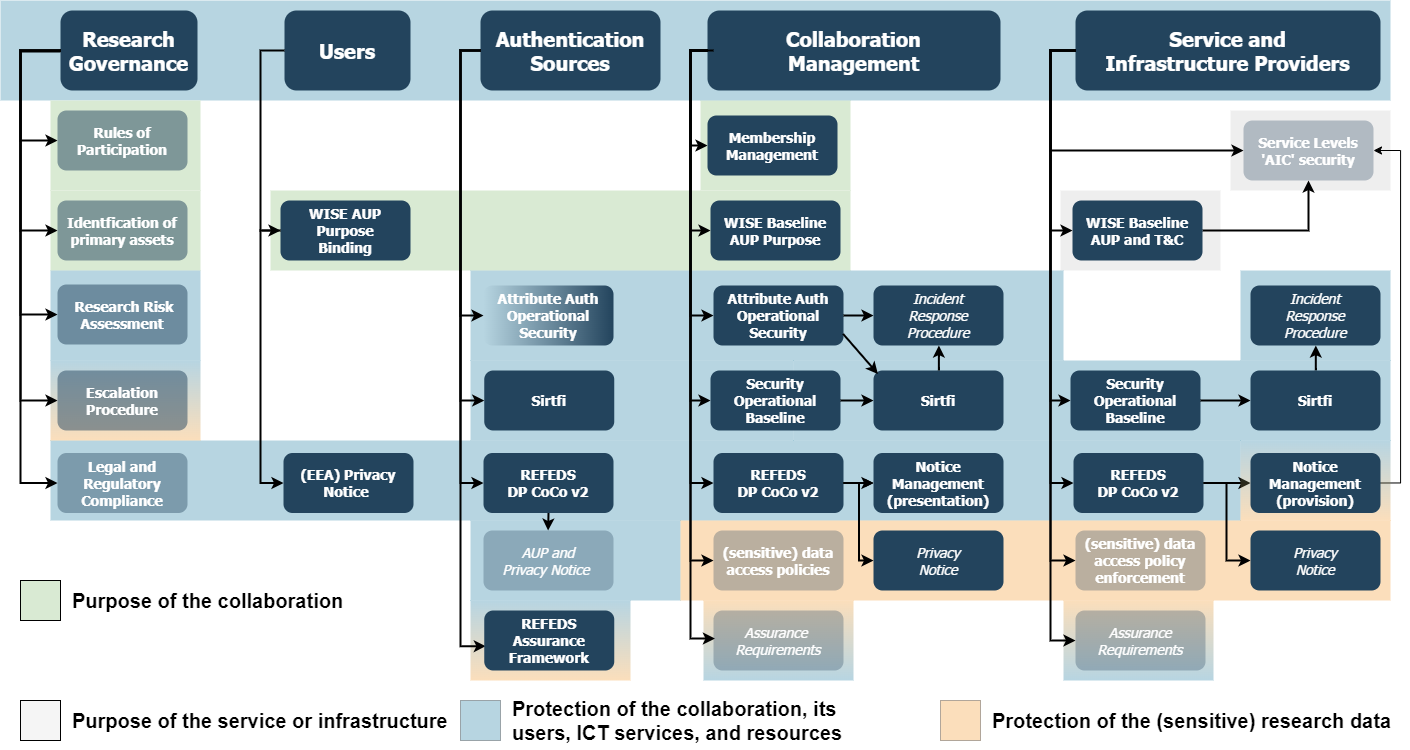
Note: we are missing DP CoCo from these steps
| Document | AARC template for interoperability | Examples where no template is recommended for interoperability purposes |
|---|---|---|
| Membership management | Membership Management | |
| AUP | WISE AUP | |
| Privacy Policy | REFEDS privacy notice | |
| AAOPS | Attribute Authority Operational Security | |
| Security Operational Baseline | Security Operational Baseline | |
| Incident response procedure | EOSC, UK-IRIS, AARC federated incident response procedure |
-------
Full Trust Framework links
Smaller and mid-sized communities may opt to offload some of the more complex aspects of authentication and authorisation to dedicated AAI service providers. And if you operate your own AAI core components, both your users and resource providers may want to have some assurance about the trust and security posture of your AAI platform. The Snctfi suite is the set of assessable and verifiable policies and procedures in the PDK that AAI platform providers can use to make the trustworthiness of their systems transparent to users and relying parties alike.

Like Sirtfi for security incident response, Snctfi provides a self-assessment framework, but having this assessment peer reviewed brings several benefits. For one, it increases the trust others have in your platform and your assessment, making it easier for ‘as-a-service’ operators to engage with new collaborations and infrastructures. And it brings advantages to yourself as well, as you can compare notes with your peers and become better together through shared learning.
AARC does not endorse any specific AAI platform or platform provider. By asking Snctfi specific information you can inform yourself about the suitability of provider of your choice, and work with them to ensure your bases are covered with a secure, resilient, and interoperable AAI.
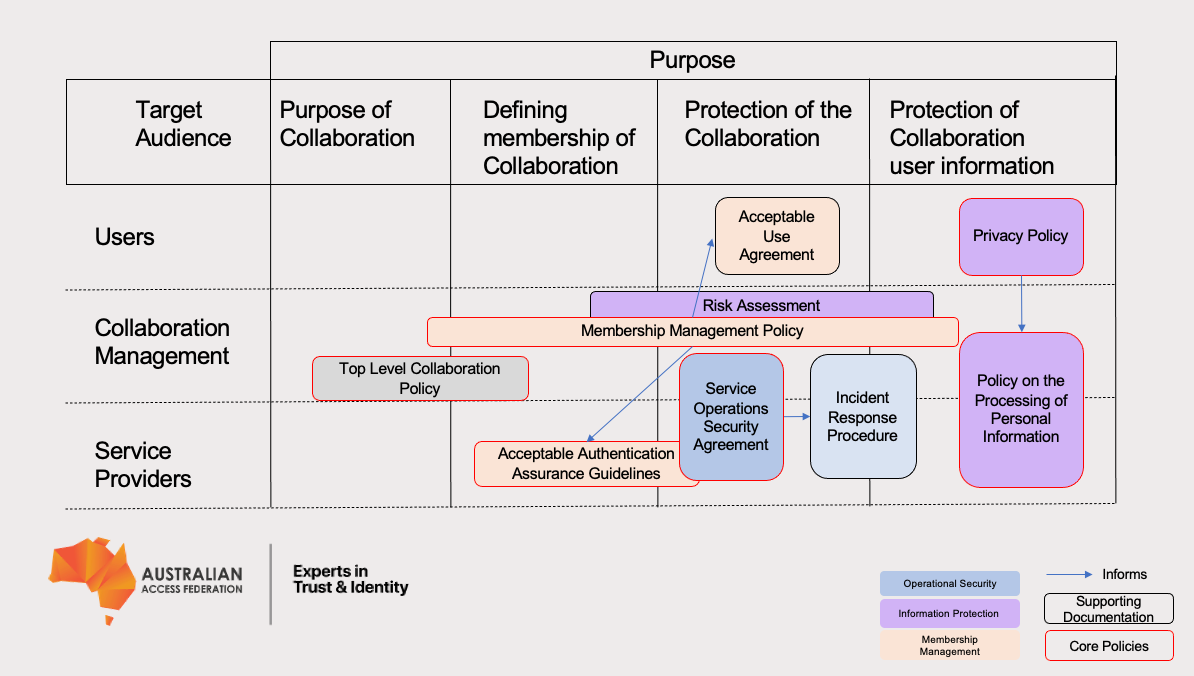 The first AARC Policy Development Kit, released in 2017, comprised a set of nine reference documents (mostly templates) addressing the construction and operation of community AAIs in the original AARC "2019" Blueprint Architecture, based on the Community First Approach. A mix of policies and procedures, its primary audience was primarily larger-scale research collaborations, expected to review, augment, and specialise the templates for their own use. With the policy development kit being created prior to or in parallel to other work in the community at large, it duplicated some aspects (privacy in REFEDS DPCoCo, or incident response work parallel to the eduGAIN Security Handbook), while being overly complex for smaller collaborations. Work by the Australian Access Federation, the AARC Community, and in REFEDS, WISE, IGTF, and the e-Infrastructures helped restructure the PDK into the model presented above.
An analysis of the improvements required on PDK v1 is included in the informational document AARC-I082 "Trust framework for proxies and Snctfi research services" (doi:10.5281/zenodo.15506826)