

Software Licensing Guides Series
- Software Licence Management
- Software Licence Selection and Management in GÉANT
- Open Source Licences Used in GÉANT
- Templates and Examples for Software Project Artefacts (for GÉANT participants)
- Software Artefacts Checklist
- FAQ – Software Licensing Practices
- OSS Licences and Licence Selection
- Reference Information about OSS Licences and Tools
- Glossary – Open Source Software and Licensing
A PDF version of this document is attached.
This work is licensed under CC BY-SA 4.0
Table of Contents
Executive Summary
This document provides a comprehensive overview of the main open source licences for GÉANT Software Developments teams. It highlights the importance of licence compliance and offers recommendations for selecting the appropriate licence for GÉANT projects by describing each licence’s specific requirements, compatibility, and patent provisions. By following the recommendations and guidelines outlined in this document, GÉANT software development teams can ensure that their projects remain compliant with OSS licences and contribute to the open source community. Ensuring compliance with these licences and understanding their interactions facilitates better governance and reduces legal risks. For further assistance and guidance on OSS and licensing in GÉANT software developments, please contact the GÉANT OSLS team at osls@geant.org.
Introduction
Open source licences can be classified into several categories. Below is a brief list of these categories:
Public Domain is the most permissive model and is not technically a licence. It is not always possible to waive all rights under the laws of some countries. In such cases, the CC0 public domain dedication can replace the public domain for practical purposes. Software in the public domain carries no potential liability. Its modified code can be licensed under any terms, making it usable in both open source and commercial software by allowing derived works to be distributed without disclosing any source code.
Permissive Licences impose minimal requirements on how software may be modified or redistributed. Almost two-thirds of open source software in circulation uses this type of licence.
Copyleft Licences allow the modification of code and the distribution of new works based on it, provided the requirements for redistribution under the same conditions are met.
- Weak Copyleft Licences have a library or file scope.
- Strong Copyleft Licences often require releasing the entire project or product under a licence that is the same as or similar to the one used in the original works.
- Network Protective Licences treat distribution over a network as a form of distribution, thus requiring modified code to be made available to external users.
Every licence listed below is classified into one of the above categories, under the title containing the licence name. For easier use with Mend reports, the licences are presented alphabetically after being grouped into IPR risk categories. Mend defines three risk categories for software licences: Low Risk, Medium Risk, and High Risk. These categories broadly correspond to Permissive, Weak Copyleft, and Strong Copyleft licences. However, this classification is not strict (e.g. Artistic 2.0 is a permissive licence but belongs to Mend’s Medium Risk category). In this document, licences are listed alphabetically within each risk category. Only licences detected by Mend in GÉANT software projects are included.
Licence Compatibility
The most frequently used licences in GÉANT software projects and their relationships are shown in Figure 1.
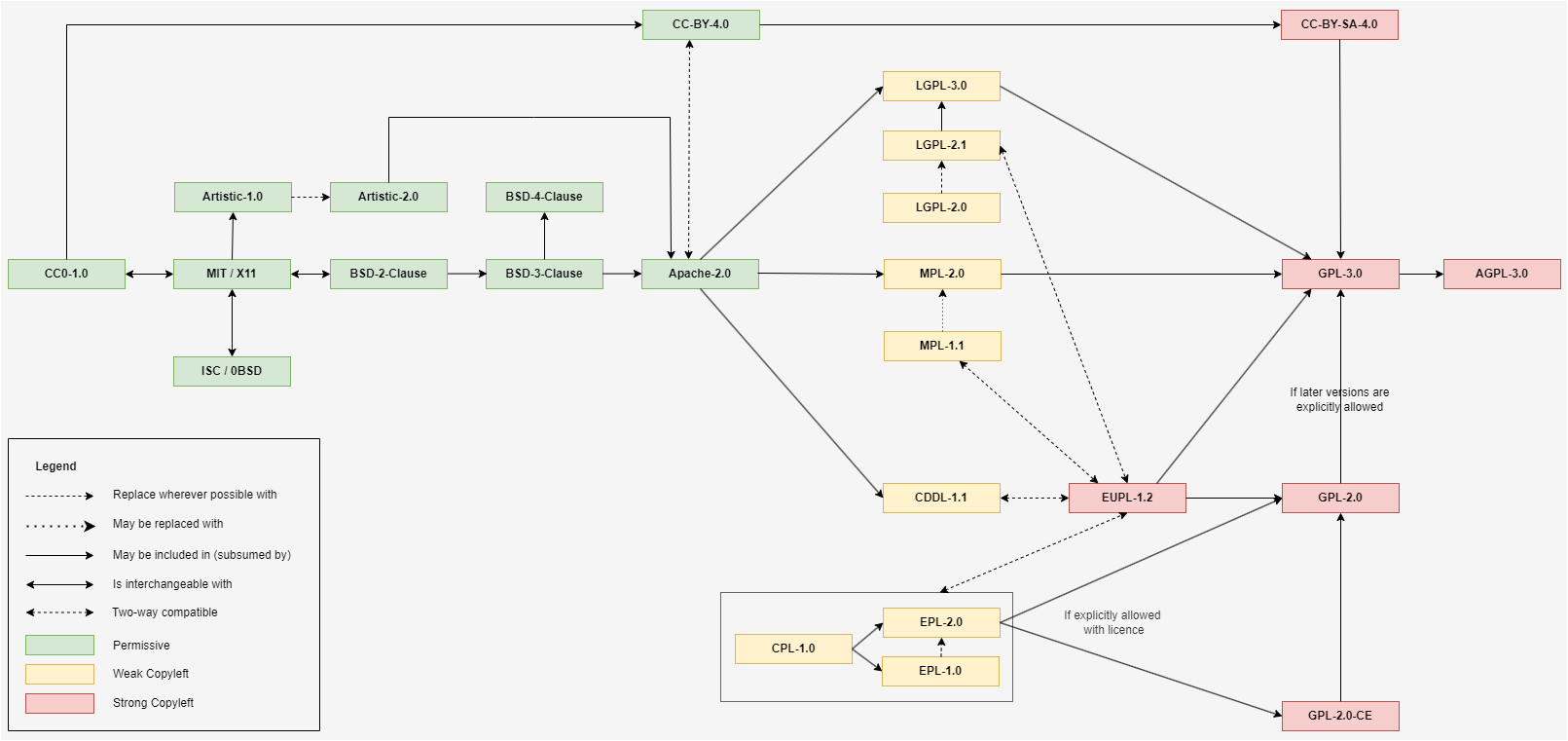
Figure 1: Relationships between the most frequently used licences in GÉANT projects
In Figure 1, different colours indicate categories of software licences. Licences marked in green are permissive, those in yellow are weak copyleft, and those in red are strong copyleft. Relationships between licences are illustrated using different arrow styles:
- A one-way solid arrow means the destination licence subsumes the origin licence. In some cases, as noted in Figure 1, additional conditions may apply.
- A one-way dashed arrow indicates that there is a newer version of the licence, suggesting the author should replace the older version in their code.
- A one-way dotted arrow signifies that the older licence can be replaced with the new version by an author using and modifying the code or mixing it with their own, provided the original code has not been distributed with additional licences.
- A two-way solid arrow means both licences are interchangeable.
- A two-way dashed arrow signifies that authors can license combined work under either of the licences. For better future compatibility, it is recommended to publish the combined work under both.
In this document, the statement “Licence A is subsumed by Licence B” means that code under Licence A can be included in work licensed under Licence B, represented in Figure 1 by an arrow from A to B. This is equivalent to stating “Licence B subsumes Licence A.” When Licence A is subsumed by Licence B, a copy of Licence A must still be included with all distributions of the combined program. “Interchangeable” means that code under Licences A and B can be licensed under either one. “Licence A is compatible with Licence B” means it is permitted to publish or distribute combined work under a licence, typically at least one of the input licences. In other words, when licences are compatible, it is legally possible to combine or merge multiple pieces of software. These nuances matter when selecting a licence for the combined program.
Open source software licences typically require the licence to be kept with the code it covers, usually by including its original text or a reference to it. Strictly speaking, the licence of the combined program absorbs (i.e. subsumes), rightfully replaces, or is interchangeable with the licences of all its parts. Below is a summary of the procedure for licensing a combined program.
To determine which licences can be used for a combined program, authors should start with a list of all the licences used in their work. They can then remove any licence subsumed by another on the list, meaning the code under it can be included in software under the other licence. A licence is subsumed by another when compliance with the former implies compliance with the latter. For example:
- LGPL 2.1 is subsumed by LGPL 3.0 and both are subsumed by GPL 3.0 and AGPL 3.0.
- LGPL 2.0 and GPL 2.0 are not automatically subsumed by LGPL 3.0 and GPL 3.0.
- The Apache 2.0 licence is subsumed by any GNU licence, version 3.0 or later.
- Mozilla Public Licence 2.0 is subsumed by GNU GPL, version 2.0, 3.0 or later.
- BSD, Expat, MIT/X11, and ISC licences, and the CC0 public domain dedication are subsumed by the Apache 2.0 licence.
- Expat, MIT/X11, and ISC licences are interchangeable with the BSD 2-Clause licence.
- BSD 2-Clause is subsumed by BSD 3-Clause.
In this document, the phrase “generally considered” is used to indicate that there is no explicit statement of the relationship in the licence text, but it is inferred from the licence clauses and lacks legal precedent.
The recommendations in this guide aim to minimise the risks of incompatibility and maximise the ability to reuse and combine covered source code and its licence(s). This follows the principle that source code developed or modified with public funding should remain public. The EUPL 1.2 licence, like other copyleft licences, preserves the public nature of the covered code while offering maximum compatibility with other licences. It therefore combines many advantages of strong copyleft without the restrictive nature of viral clauses, allowing free combination and linking of differently licensed components and covering all distribution modes, including remote distribution (SaaS).
Works analysed by Mend sometimes have dual licences. Dual and multi-licensing involve releasing the same code under multiple licences, allowing users to choose which to apply provided the project complies with the requirements of all offered licences. This increases compatibility options for users and enhances flexibility when selecting components or licensing their own code. Conversely, when different components within a project use different licences, the project should be described as using “multiple licences” rather than being multi-licensed. Mend, however, displays a list of licences in both cases.
In dual licensing, copyleft licences are often presented as one option because they impose strict open source conditions on users’ code. This drives users unwilling to comply with these conditions to select the alternative, typically a commercial licence. Offering a permissive licence instead would remove the incentive to choose the commercial option. This approach, known as “Choice of Licence,” enables casual or small-scale users to use the software free of charge, while enterprise users or those incorporating the software into products must choose the commercial licence.
Multiple permissive licences may also be offered in multi-licensing arrangements to ensure compatibility with projects under various licences, as no single licence may suit all. For example, since GPL v2 cannot be combined with Apache 2.0, authors may dual-license their project under both to allow use under either.
Relicensing and Sublicensing
Relicensing is the act of changing the current licence to another. This is possible if the original licence is permissive (allowing licence changes), explicitly permits relicensing to a secondary licence, or if all contributors agree. Scenarios include:
- Switching to another copyleft licence explicitly allowed by the original licence (e.g. CeCILL permits relicensing to GPL v2 or later).
- Changing the licence entirely, which requires written permission from all contributors. Permissive licences often do not explicitly mention relicensing or sublicensing, but their terms effectively allow it.
Projects under permissive licences can also be relicensed, changing the licence of the original or modified code. Relicensing is sometimes used to apply a commercial licence or a “fauxpen” source-available licence, which may be undesirable if the original intent was to keep the software open. Copyleft licences generally prohibit relicensing for the code within their scope, requiring redistribution under the same terms.
Sublicensing allows the licencee (the individual or organisation granted the licence) to grant rights under the original licence to a third party, without transferring copyright or changing the licence. Permissive licences typically grant sublicensing rights, though with varying conditions. Sublicensing depends on the terms of the original licence, which may not even be an OSS licence. This can be essential for broader distribution, integration, or software use. Common use cases include:
Commercial distribution, granting rights to customers as part of a product or service offering.
Partnerships, granting rights to collaborators for joint projects.
Custom solutions, providing components for client-specific applications or bespoke solutions.
Whether a third party can further sublicense depends on the original licence. Permissive licences usually allow broad downstream sublicensing, while strong copyleft licences restrict sublicensing to redistribution under the same licence.
Copyright, Patents and Trademarks
Preserving original copyrights and notices is a key legal and ethical requirement when using, modifying, or distributing software. These notices ensure proper recognition of the original creators and maintain the integrity of the licence terms.
Patents and patent rights are sometimes addressed in licences through explicit patent grants, as seen in LGPL, GPL, AGPL, Apache 2.0, EPL, and EUPL. Some licences do not mention patent rights explicitly, but their language may imply such grants. Patent-related concerns may arise when derived works are distributed under a different licence along with permissively licensed original parts. Licence texts may include patent-related clauses such as:
- Defensive termination, which automatically revokes patent rights if the licencee initiates patent litigation against the authors or contributors.
- Broad patent grants, covering all current and future patents owned by contributors that could be infringed by the entire codebase and through modifications or combinations, not just by specific contributions.
Most open source licences exclude trademark rights unless explicitly stated. Trademarks of the original work are typically preserved through applicable trademark law and supported by the licence’s requirement to include copyright notices. However, some licences regulate trademark use explicitly:
- Apache 2.0: “… does not grant permission to use the trade names, trademarks, service marks, or product names of the Licensor…”
- BSD 3- and 4-Clause: the non-endorsement clause prohibits use of project and contributor names without written permission.
- Artistic 2.0: “… does not grant you the right to use any trademark, service mark, tradename, or logo of the Copyright Holder.”
Low Risk Licences
Apache-2.0
Permissive
Description: The Apache 2.0 licence is widely used and allows software use, distribution, and modification for any purpose. Derivative works can have stricter licences, but unaltered components must use the Apache 2.0 licence. It has strong OSI community support. Unlike MIT, recipients receive a patent licence. Applicable law and competent court are unspecified.
Requirements and mixing: The original copyright notice should be included in a separate file, and the NOTICE file with attribution notes (if present) from the original library should be copied. The source code should include the licence text and a notice of significant changes in files that were changed. There is no obligation to disclose the affected source code, but modification notifications must be included. Sublicensing of relevant code is permitted.
Compatibility, linking, and mixing: The licence is subsumed by GPL 3.0, LGPL 3.0, and CDDL. It is two-way compatible with MIT, BSD (2- and 3-Clause), and MPL 2.0. It is linking-permissive.
Patent rights: Patent rights to the software user or developer are explicitly granted.
Remarks: The Apache licence does not grant trademark rights, implying that users cannot use the project’s name or associated trademarks without explicit permission.
Bouncy Castle License
Permissive
Description: The Bouncy Castle License should be read similarly to the MIT licence. It is specific to the Bouncy Castle Crypto APIs, a widely used cryptography library in Java and C#. The licence is business-friendly while promoting the use of strong cryptography.
Requirements: The source code should include notice files and the original licence. Users must retain and add new attributions for copyright, authorship and recognition. Modified files must be marked as such to maintain transparency. Users are allowed to sublicense the software and its modifications.
Compatibility, linking, and mixing: Code under MIT, BSD (2- and 3-Clause), Apache 2.0, and MPL 2.0 can be combined with code under the Bouncy Castle License and published under any of the input licences. Code under the Bouncy Castle License can be included in projects licensed under GPL and LGPL.
Patent rights: Patent rights are not mentioned.
BSD-2-Clause
Permissive
Description: BSD licences are a family of permissive licences with minimal restrictions on the redistribution of covered software. The BSD 2-Clause licence is the simplest BSD licence and the most compatible with other licences.
Requirements: The original copyright notice should be added to the licence text. The source code should include the licence text. There is no need to include a notice of significant changes. There is no obligation to disclose affected source code. Sublicensing of relevant code is permitted.
Compatibility, linking, and mixing: It is subsumed by the entire GPL family (including LGPL and AGPL licences) and is linking-permissive. The BSD 2-Clause licence is interchangeable with MIT and ISC licences. MPL and Apache 2.0 licences are two-way compatible with the BSD 2-Clause licence. BSD 2-Clause is subsumed by BSD 3-Clause and 4-Clause licences.
Patent rights: Patent rights are not mentioned.
Remarks: There is no prohibition on using the name of the project to promote work.
BSD-3-Clause
Permissive
Description: In addition to the conditions in the BSD 2-Clause licence, the author’s name may not be used to endorse or promote products derived from this software without specific prior written permission.
Requirements: The original copyright notice should be included in the licence text. The source code should contain the licence text, but there is no need to include a notice of significant changes. There is no obligation to disclose affected source code. Sublicensing of relevant code is permitted.
Compatibility, linking, and mixing: The licence is subsumed by GPL and LGPL licences. ISC, MIT, MPL, and Apache 2.0 are two-way compatible with BSD 3-Clause. BSD 3-Clause is subsumed by BSD 4-Clause. It is linking-permissive.
Patent rights: Patent rights are not mentioned.
Remarks: Non-endorsement clause: the name of the project or its contributors may not be used without written permission.
BSD-4-Clause
Permissive
Description: In addition to the conditions in the BSD 3-Clause licence, neither the name of the copyright holder nor the names of its contributors may be used to endorse or promote products derived from this software without specific prior written permission.
Requirements: The original copyright notice should be added to the licence text. The source code should include the licence text and an acknowledgment statement. There is no need to include a notice of significant changes. There is no obligation to disclose affected source code. Sublicensing of relevant code is permitted.
Compatibility, linking, and mixing: BSD 4-Clause is not GPL compatible and may cause issues when combined with other licences. Due to the advertising clause, BSD 4-Clause is not compatible with other licences, especially those that explicitly prohibit additional requirements, mandate uniform terms for redistribution, or avoid endorsement-style obligations. Nonetheless, it subsumes other BSD licences.
Patent rights: Patent rights are not mentioned.
BSL-1.0
Permissive
Description: The Boost Software License (BSL) imposes minimal restrictions on code use and redistribution. Initially created for the Boost C++ Libraries, BSL encourages open collaboration in a business-friendly and flexible manner.
Requirements: The source code should include the original copyright notice. This requirement does not apply when distributing compiled code. The licence text should also be included, but a notice of significant changes is not necessary. There is no obligation to disclose affected source code. Users have the right to sublicense the software and its modifications, providing additional flexibility in licensing for downstream recipients.
Compatibility, linking, and mixing: BSL is subsumed by the entire GPL family (including LGPL and AGPL licences) and is linking-permissive. BSL is two-way compatible with MIT, BSD (2- and 3-Clause), Apache 2.0, and MPL. It can be included in projects licensed under Apache 2.0.
Patent rights: Patent rights are not mentioned, but are considered implicitly granted.
CC0-1.0 / WTFPL / Unlicense
Public Domain
Description: These licences effectively dedicate a work to the public domain to the fullest extent permitted by law. They also provide lax licences to cover cases where a simple dedication is inadequate. Only Unlicense is OSI-approved.
Requirements: No copyright notice or licence text is required (CC0 suggests attribution on moral grounds). The source code does not need to include a notice of significant changes. There is no obligation to disclose modified source code. Sublicensing of relevant code is permitted.
Compatibility, linking, and mixing: As public domain dedication tools or waivers, these licences can be inherently subsumed by all licences and works and are linking-permissive.
Patent rights: Patent rights are not mentioned (in the case of CC0, they are not granted).
CC-BY-4.0
Permissive
Description: A permissive licence that provides flexibility for both commercial and non-commercial use, making it suitable for projects and initiatives that value openness, collaboration, and the free exchange of ideas and content. However, CC BY 4.0 is not intended for software.
Requirements: Original copyright notice should be included in the licence text. The source code should include the licence text or a URL linking to it. There is no requirement to include a notice of significant changes. There is no obligation to disclose affected source code. Sublicensing of relevant code is permitted.
Compatibility, linking, and mixing: The licence is subsumed by all GPL and LGPL licences. ISC, BSD, MIT, MPL, and Apache 2.0 are two-way compatible with CC BY 4.0. It is linking-permissive.
Patent rights: Patent rights are not granted.
CC-BY-SA-4.0
Strong Copyleft
Description: The Creative Commons Attribution-ShareAlike 4.0 International (CC BY-SA 4.0) licence is widely used for creative works such as text and images, allowing creators to share their works while retaining attribution rights and copyleft-style control. It is not intended for software but is suitable for documentation, allowing sharing and modification under clear attribution and share-alike terms. This distinction ensures documentation remains independent of software licensing considerations, providing clarity and legal compliance.
Requirements: The original copyright notice should be added to the licence text. The source code should include the licence text or a URL link to it. Any modifications should be noted, and previous notices retained. There is no obligation to disclose affected source code. Sublicensing of relevant code is not allowed.
Compatibility, linking, and mixing: This licence is subsumed by GPL 3.0 but not by GPL 2.0. CC BY-SA 4.0 subsumes CC BY 4.0, CC BY-NC-SA 4.0, and other CC 4.0 licences. It is not linking-permissive and is typically used for data, databases, and other content. If content licensed under this licence is part of a software package, the licence does not extend to the software as a whole. Modified content must remain under the same licence.
Patent rights: Patent rights are not granted.
CDDL-1.0
Weak Copyleft
Description: The Common Development and Distribution License (CDDL) is derived from the Mozilla Public License 1.1. CDDL is used primarily for Oracle-related projects, allowing both commercial and non-commercial use.
Requirements: The original copyright notice, licence text, and a list of conditions must be retained in the software documentation or other materials provided with the distribution. Both the original source code and modified derivatives must be made available. Sublicensing of relevant code is permitted.
Compatibility, linking, and mixing: CDDL 1.0 is considered incompatible with GPL. CDDL is generally considered two-way compatible with 2- and 3-clause BSD, MIT, and Apache 2.0 licences. It is linking-permissive.
Patent rights: The licence includes a patent grant clause, providing a limited patent licence to the patents owned by contributors.
CDDL-1.1
Weak Copyleft
Description: CDDL 1.1 includes corrections to address conflicts with European copyright law found in CDDL 1.0 and allows individual developers to use the CDDL for their work. It is considered a weak copyleft licence, with copyleft applying at the file level.
Requirements: The original copyright notice should be added to the licence text. The source code should also include the licence text. While it is not mandatory to include a notice of significant changes, affected source code must be disclosed when distributing the work. Developers should ensure that derivative work is licensed under the same version of the licence.
Compatibility, linking, and mixing: CDDL 1.1 is not compatible with the entire GPL family (including LGPL and AGPL licences). It is generally considered two-way compatible with 2- and 3-clause BSD, MIT, MPL 2.0, and Apache 2.0. It is permissible to combine CDDL-licensed code with software under other licences to create an aggregate “larger work,” which can be kept proprietary or released under a different licence. It is linking-permissive.
Patent rights: Patent rights are explicitly granted. Contains a patent infringement termination clause.
Remarks: It is recommended to use dynamic linking in programming languages that also support static linking.
Golang BSD + Patents
Permissive
Description: The Golang BSD + Patents licence is based on the BSD 3-Clause licence and includes explicit patent rights.
Requirements: The original copyright notice should be added to the licence text. The source code should include the licence text but does not require a notice of significant changes. There is no obligation to disclose modified source code. Sublicensing of relevant code is permitted.
Compatibility, linking, and mixing: The licence is subsumed by all GPL and LGPL licences. Code under 2- and 3-clause BSD, MIT, and Apache 2.0 licences can be combined with code under Golang BSD + Patents under either of the input licences. It is two-way compatible with MPL. It is linking-permissive.
Patent rights: The licence includes a patent grant.
Remarks: It is essentially the BSD 3-Clause licence with the added condition that users cannot sue Google for licence infringement.
ISC / 0BSD
Permissive
Description: The ISC licence is a “stripped-down” version of the MIT and BSD 2-Clause licences, removing extraneous language. Despite its name, the 0BSD licence is a simplified version of the ISC licence, eliminating even the requirement to include a copyright notice. All other requirements, compatibility, and mixing rules also apply to 0BSD.
Requirements: The original copyright notice should be added to the licence text (0BSD does not require it). The source code should include the licence text but does not need to include a notice of significant changes. There is no obligation to disclose affected source code. Sublicensing of relevant code is permitted.
Compatibility, linking, and mixing: It is linking-permissive. The ISC licence is generally considered interchangeable with other permissive licences like MIT and BSD 2-Clause. It is two-way compatible with BSD 3-clause. ISC-licensed code can be included in projects licensed under GPL, LGPL, MPL, Apache 2.0, and CDDL.
Patent rights: Patent rights are not mentioned.
MIT / X11
Permissive
Description: The MIT licence is highly compatible with other permissive licences.
Requirements: The original copyright notice should be added to the licence text. The source code should include the licence text but not a notice of significant changes. There is no obligation to disclose modified source code. Sublicensing of relevant code is permitted.
Compatibility, linking, and mixing: The MIT licence is linking-permissive. Code under BSD 2-Clause and ISC licences can be freely combined with MIT-licensed code and published under each of these licences. BSD 3-Clause, MPL, and Apache 2.0 licences are two-way compatible with the MIT licence. MIT-licensed code can be used in GPL, LGPL, and CDDL-licensed projects.
Patent rights: Patent rights are not mentioned, but are implicit in the USA due to “without restriction.”
Remarks: It allows the use or mention of trademarks except for X11, which forbids usage of the X Consortium name without prior written authorisation.
NUnit
Permissive
Description: NUnit is a unit-testing framework for all .NET languages. Newer versions (starting from 3.0) are released under the MIT licence while older versions use the zlib/libpng licence. The licence allows the use of NUnit in free and commercial applications and libraries without restrictions.
Requirements: By association with the MIT licence, the original copyright notice should be added to the licence text. The source code should include the licence text but not a notice of significant changes. There is no obligation to disclose modified source code. Sublicensing of relevant code is permitted.
Compatibility, linking, and mixing: NUnit is linking-permissive by association with the MIT licence. Code under BSD 2-Clause, ISC, and other MIT-licensed code may be freely combined and published under either of the input licences. BSD 3-Clause, MPL, and Apache 2.0 licences are two-way compatible with the NUnit licence. NUnit-licensed code can be used in GPL, LGPL, and CDDL-licensed projects.
Patent rights: By association with the MIT licence, patent rights are not mentioned, but are implicit in the USA due to “without restriction.”
OpenSSL
Permissive
Description: The OpenSSL License is the original licence used for the OpenSSL project before version 3.0. The last version of this licence is OpenSSL License 1.1. It combines texts from the Apache 1.0 licence (OpenSSL part) and the BSD 4-Clause licence (Original SSLeay part).
Requirements: Redistributions of source code must retain the copyright notice, the list of conditions, and the disclaimer of warranty. The source code should include the licence text but not a notice of significant changes. There is no obligation to disclose modified source code. Sublicensing of relevant code is permitted.
Compatibility, linking, and mixing: The OpenSSL licence is linking-permissive. It requires the phrase “this product includes software developed by the OpenSSL Project for use in the OpenSSL Toolkit,” making it similar to the Apache 1.0 licence and incompatible with all GPL family licences. The original SSLeay License includes the phrase “This product includes cryptographic software written by Eric Young (eay@cryptsoft.com),” a characteristic of the BSD 4-Clause licence, making it incompatible with other licences, especially those with more restrictive terms prohibiting the additional advertising clause requirement. It subsumes 2- and 3-clause BSD licences. All inherited issues have been resolved in newer versions (3.0 and greater) of OpenSSL software, which use the Apache 2.0 licence.
Patent rights: Patent rights are not mentioned.
Public Domain
Public Domain
Description: Public domain is not a licence per se, but a “public domain dedication” means the creator relinquishes all rights to a work, placing it in the public domain. This allows anyone to freely use, modify, distribute, and adapt the work without restrictions or licensing conditions. Since public domain is usually implicit, it is often formalised by applying the CC0 dedication.
Requirements: None.
Compatibility, linking, and mixing: There are no conflicts or restrictions related to licence compatibility when using or combining public domain works with works under any other licence, whether open source or proprietary. This means that public domain is subsumed by any licence.
Patent rights: Unlicense and WTFPL, as public-domain equivalent formalisations, grant all rights, functioning as unconditional waivers.
Python-2.0
Permissive
Description: Primarily used for the distribution of Python project software and documentation.
Requirements: The source code should include the original copyright notice and licence text. The source code should include notices of significant changes. There is no obligation to disclose modified source code. Sublicensing of relevant code is permitted.
Compatibility, linking, and mixing: Python licences are subsumed by GPL and LGPL except for versions Python 1.6b1 through 2.0 and 2.1. Code under MIT, Apache 2.0, MPL, 2- and 3-clause BSD can be combined with Python 2.0-licensed code since they are considered two-way compatible. The Python 2.0 licence is subsumed by the CDDL 1.1 licence. It is linking-permissive.
Patent rights: Patent rights are not mentioned.
Zlib
Permissive
Description: The Zlib licence is used for a variety of software libraries and applications, named after the zlib compression library and the libpng library for working with PNG image files.
Requirements: The source code should include the original copyright notice for source code only. It should include the licence text for source code only. It should include a notice of significant changes. There is no obligation to disclose affected source code. Sublicensing of relevant code is permitted.
Compatibility, linking, and mixing: Code under MIT and BSD licences (2- and 3-clause), Apache 2.0, and MPL can be combined with code under the Zlib licence (two-way compatible). Code under the Zlib licence can be used in GPL, LGPL, and CDDL-licensed projects. It is linking-permissive.
Patent rights: Patent rights are not mentioned.
Medium Risk Licences
Artistic-1.0
Permissive
Description: According to the FSF, Artistic 1.0 is not considered a free software licence, as it contains passages lacking clear meaning, and is therefore not compatible with the GPL. It is primarily used for Perl programming language software and related projects (also modified as Artistic Perl 1.0). Authors are recommended to replace Artistic 1.0 with Artistic 2.0 whenever possible due to compatibility issues.
Requirements: The source code should include the original copyright notice and licence text. Any differences should be clearly documented, although you do not have to disclose a modification if it can be replaced with the original in the combined work, or if it is available to the original work’s copyright holder. Sublicensing of relevant code is permitted.
Compatibility, linking, and mixing: Code under the Apache 2.0, MPL, MIT and BSD licences (2- and 3-clause) may be combined with code under Artistic 1.0 and published under either of the input licences. This is subject to specific Artistic 1.0 requirements, such as marking modifications and preserving copyright notices. It is linking-permissive.
Patent rights: Patent rights are not granted.
Artistic-2.0
Permissive
Description: Artistic 2.0 is compatible with the GPL, thanks to the relicensing option in section 4(c)(ii). It is primarily used for Perl programming language software and related projects. Wherever possible, it is recommended to replace Artistic 1.0 with Artistic 2.0 due to compatibility issues. Licensing compatibility is greatly improved with the relicensing clause.
Requirements: The source code should include the original copyright notice and licence text. Differences should be clearly documented, but modifications do not need to be disclosed if they can be replaced with the original in the combined work, or if they are available to the original work’s copyright holder. Sublicensing of relevant code is permitted.
Compatibility, linking, and mixing: Code under Apache 2.0, MPL, MIT, 2- and 3-clause BSD may be freely combined with code under Artistic 2.0 and published under either of the input licences. Code under Artistic 2.0 can be used in GPL, LGPL and CDDL-licensed projects. It is linking-permissive.
Patent rights: Patent rights are explicitly granted.
EPL-1.0
Weak Copyleft
Description: The Eclipse Public License (EPL) is similar to the Common Public License, with the removal of broader patent retaliation language regarding patent infringement suits specifically against “Contributors to the EPL program.” EPL-licensed code in a program can only be released under the EPL, even if the full program is released under a different licence. It should be replaced with EPL 2.0 wherever possible.
Requirements: The source code should include the original copyright notice, licence text and notices of significant changes. You should disclose the affected source code when distributing work. Sublicensing of relevant code is permitted. A distributor can relicense to EPL 2.0.
Compatibility, linking, and mixing: EPL 1.0 is not compatible with the entire GPL family, including LGPL and AGPL licences. EPL 1.0-licensed code can be migrated to EPL 2.0 and vice versa. Code under MIT, Apache 2.0, MPL 2.0, 2- and 3-clause BSD can be combined with EPL 1.0-licensed code, although it requires licensing EPL 1.0 parts under the EPL 1.0 licence. It is linking-permissive.
Patent rights: Patent rights are explicitly granted.
Remarks: Unlike EPL 2.0, it is not suitable for scripting languages as it does not require source code to be made available; there is no secondary licence. New York State is defined as the “choice of law.” The affected code is defined as a “module,” not a file.
EPL-2.0
Weak Copyleft
Description: If an initial contributor releases a specific piece of code and designates GPL 2.0 or later as a secondary licence, it provides explicit compatibility with these GPL versions. However, EPL 2.0 without this designation is incompatible with the GPL.
Requirements: The source code should include the original copyright notice and licence text. While the source code does not need to include a notice of significant changes, you should disclose the affected source code when distributing the work. Sublicensing of relevant code is permitted. The same or later EPL is applicable for affected code, and you can add a secondary licence to enable GPL 2.0+ compatibility, allowing sublicensing of binaries under other terms.
Compatibility, linking, and mixing: It is not compatible with the entire GPL family, including LGPL and AGPL licences, except for special cases stated in the “Description.” EPL 2.0 and EPL 1.0 are generally considered interchangeable. Code under MIT, Apache 2.0, MPL 2.0, 2- and 3-clause BSD can be combined with code under EPL 2.0, although the EPL 2.0 parts must remain under the EPL 2.0 licence. It is linking-permissive.
Patent rights: Patent rights are explicitly granted.
Remarks: Commercial distributors should defend contributors from any lawsuits or legal damages, which is a unique feature of this licence.
EUPL-1.2
Strong Copyleft
Description: The European Union Public Licence 1.2 is designed for software created and distributed by public administrations of European Union Member States. The EUPL aims to promote the sharing and reuse of software developed by public administrations.
Requirements: The source code should include the original copyright notice and licence text. It should include notices of significant changes and you should disclose affected source code when distributing work. Sublicensing of relevant code is permitted.
Compatibility, linking, and mixing: It is subsumed by GPL 2.0 or later, AGPL 3.0, CeCILL 2.0, OSL 2.1, and OSL 3.0. EUPL 1.2 is explicitly two-way compatible with LGPL 2.1 or later, LiLiQ, CeCILL 2.1, CPL 1.0, EPL 1.0 or later, MPL 1.1 or later, and other EUPL versions. EUPL 1.2 subsumes Apache 2.0, Artistic, BSL 1.0, 2- and 3-clause BSD, CDDL 1.0 or later, ISC, MIT, Python 2.0 and Zlib. It is linking-permissive, as linking does not create derivatives. When combining EUPL 1.2-licensed code with source code licensed differently, the resulting derivative can be licensed under a subsuming licence.
Patent rights: Patent rights are explicitly granted.
GPL-2.0-with-classpath-exception
Strong Copyleft
Description: The exception allows you to link your GPL-licensed code with specific non-GPL libraries, such as the Java Classpath libraries, without making your code subject to the GPL. The Classpath exception only applies to the specific libraries or circumstances mentioned in the exception itself.
Requirements: The source code should include the original copyright notice and licence text. It should include notices of significant changes, including dates. When distributing any derived work, you must disclose the affected source code, but this is not required for private use. You cannot sublicense the relevant code.
Compatibility, linking, and mixing: It is subsumed by the entire GPL family, including LGPL and AGPL licences. The Classpath exception allows GPL-licensed code to be linked with specific non-GPL libraries without imposing GPL requirements on the entire work. It is linking-permissive only for executables.
Patent rights: Patent rights are not mentioned, but are considered implicitly granted.
LGPL-2.0
Weak Copyleft
Description: The Library GPL 2.0 is an older version of the LGPL and is now considered obsolete. It should be replaced with version 2.1. LGPL is primarily used for software libraries, enabling their use in open source and proprietary applications. Under the LGPL, you only need to share modifications to the library, and you can dynamically link it in your application without sharing your application’s source code.
Requirements: The source code should include the original copyright notice and licence text. Additionally, the source code should include notices of significant changes, including dates, and you should disclose the affected source code when distributing work. You cannot sublicense the relevant code. Modifications to LGPL 2.0-licensed libraries must be released under LGPL 2.0, but the rest of the application can be under any licence.
Compatibility, linking, and mixing: LGPL 2.0 is subsumed by GPL 2.0, but not compatible with GPL 3.0, and is linking-permissive. It permits dynamic linking of the library with both open source and proprietary applications. This allows mixing of LGPL 2.0 code with MIT, 2- and 3-clause BSD, Apache 2.0 and CDDL. If the library is statically linked with an application, the application must also be made available in an object code or other relevant format, allowing for modification and re-linking of the application.
Patent rights: Patent rights are not mentioned, but are considered implicitly granted.
Remarks: Use dynamic linking in languages that also have support linking.
LGPL-2.1
Weak Copyleft
Description: Lesser GPL 2.1 is an older version of the LGPL, permitting linking with modules under licences not considered free by the FSF. It clarifies linking terms of LGPL 2.0.
Requirements: The source code should include the original copyright notice and licence text. It should include notices of significant changes, including dates, and disclose the affected source code when distributing work. You cannot sublicense the relevant code. Modifications to LGPL 2.1-licensed libraries must be released under LGPL 2.1, but the rest of the application can be under any licence.
Compatibility, linking, and mixing: Derivative works of LGPL 2.1 code must be licensed under the same version, or, if allowed by the licensor, a later version of LGPL, or GPL 2.0 or later. LGPL 2.1 allows dynamic linking from code under MIT, 2- and 3-clause BSD, Apache 2.0, and MPL licences. LGPL 2.1 is explicitly two-way compatible with the EUPL 1.2 licence.
Patent rights: Patent rights are not mentioned, but are considered implicitly granted.
Remarks: Use dynamic linking in languages that also support static linking. Provide copyright and licence information in the UI if copyrights are already shown.
LGPL-3.0
Weak Copyleft
Description: Lesser GPL 3.0 is the current version of LGPL, permitting linking with non-free modules. It prohibits practices that restrict installing or running modifications.
Requirements: The source code should include the original copyright notice and licence text. It should include notices of significant changes, including dates, and disclose the affected source code when distributing work. You cannot sublicense the relevant code. Modifications to LGPL 3.0-licensed libraries must be released under LGPL 3.0 but the rest of the application can be under any licence. If the library is statically linked, object code or a suitable mechanism for re-linking must be provided.
Compatibility, linking, and mixing: Derivative works of LGPL 3.0 code must be licensed under LGPL 3.0 or GPL 3.0, or later if stated. LGPL 3.0 allows linking from code under permissive licences, such as MIT, BSD, Apache 2.0, and MPL. It is not compatible with GPL 2.0 without the “or later” clause. LGPL 3.0 is explicitly two-way compatible with the EUPL 1.2 licence. It supports both static and dynamic linking, provided re-linking is enabled.
Patent rights: Patent rights are explicitly granted under GPL 3.0 terms, which are inherited.
Remarks: Use dynamic linking in languages that also support static linking. Include installation information for consumer devices. Provide copyright and licence in the UI if copyrights are already shown.
MPL-1.1
Weak Copyleft
Description: Mozilla Public License 1.1 is a weak copyleft licence where copyleft applies at the file level, with complex restrictions that make it incompatible with the GNU GPL. A module covered by GPL and a module covered by MPL cannot legally be linked together, although MPL may include an option to choose another licence.
Requirements: The source code should include the original copyright notice and licence text. It should include notices of significant changes, including dates. When distributing combined work, you must disclose the affected source code under the same licence.
Compatibility, linking, and mixing: MPL 1.1 is not compatible with the entire GPL family, including LGPL and AGPL licences. However, code under the Mozilla 1.1 licence can include code under Apache 2.0, MIT, 2- and 3-clause BSD. It is linking-permissive.
Patent rights: MPL 1.1 includes specific provisions related to patents.
MPL-2.0
Weak Copyleft
Description: Mozilla Public License 2.0 is a weak copyleft licence applying at the file level, which permits relicensing to GPL except where explicitly denied.
Requirements: Authors must state that the code is under MPL and where to find the licence. The source code should include the original copyright notice, but does not have to state significant changes. When distributing combined works, you must disclose the affected source code. You can sublicense binaries of aggregate works. Derivative works can be licensed under any future version of the licence.
Compatibility, linking, and mixing: Software under previous versions of MPL can be upgraded to MPL 2.0. Any software not already available under one of the GNU licences listed in the licence text must be marked as “Incompatible with Secondary Licences” in places where licence use is stated, as detailed in “Exhibit B” of the licence text. MPL 2.0 is subsumed by GPL 2.0, LGPL 2.1, AGPL 3.0 and all later versions of those licences. Files originally under MPL must remain available under MPL’s terms. MPL 2.0-licensed code can be combined with code under Apache 2.0 and published under either licence. Code distributed under the Mozilla 2.0 licence can include code under ISC, MIT and 2- and 3-clause BSD . It is linking-permissive.
Patent rights: Patent rights are explicitly granted.
Remarks: MPL 2.0 does not allow the use or mention of trademarks.
High Risk Licences
AGPL-3.0
Strong Copyleft, Network Protective
Description: Affero GPL 3.0 licence terms effectively comprise those of GPL 3.0, with an additional provision requiring users interacting with software over a network to be able to receive its source code. AGPL 3.0 and GPL 3.0-licensed code can be combined into a single program under the AGPL 3.0 licence. AGPL is recommended for network-based software, but restricts future proprietary versions. If you modify AGPL software used over a network, you must provide access to the modified source code.
Requirements: Source code should include the original copyright notice and licence text. It should include notices of significant changes, including dates. You must disclose affected source code when distributing combined work. You cannot sublicense the relevant code.
Compatibility, linking, and mixing: AGPL 3.0 subsumes GPL 3.0 and is not linking-permissive.
Patent rights: Patent rights are explicitly granted under GPL 3.0 terms, which are inherited.
Remarks: AGPL’s notable feature is the additional clause addressing usage over a network. It explicitly states that if users interact with the software over a network, the server must provide the source code for that version of the program.
GPL-1.0
Strong Copyleft
Description: This version served as the foundation for subsequent GPL versions, but is no longer recommended for use due to limitations and issues addressed in later versions.
Requirements: The source code should include the original copyright notice and licence text. It should include notices of significant changes, including dates. Developers should disclose affected source code when distributing derived works, except for private use. Relevant code cannot be sublicensed.
Compatibility, linking, and mixing: It is compatible only with GPL 1.0. Code under MIT, ISC, 2- and 3-clause BSD can be used in GPL 1.0-licensed works. It is not linking-permissive. It is recommended to use newer licences that provide stronger patent protections, clearer terms, and better compatibility with other open source licences.
Patent rights: Patent rights are not mentioned.
GPL-2.0
Strong Copyleft
Description: Focuses on software licensing and distribution. It is considered very US-centric.
Requirements: Source code should include the original copyright notice and licence text. It should include notices of significant changes, including dates. You should disclose affected source code when distributing derived works, except for private use. Relevant code cannot be sublicensed.
Compatibility, linking, and mixing: It is compatible with GPL 2.0 only unless the "or later" option is used. FSF provides for original authors an upgrade option to GPL 3.0 or later for projects licensed under GPL 2.0. GPL 2.0-licensed code can be combined with AGPL 3.0-licensed code under AGPL 3.0. When distributing combined work with LGPL 2.1, you can choose to license it under either GPL 2.0 or LGPL 2.1. When distributing combined work with Apache 2.0, you must license it under GPL 2.0. Code under MIT, ISC, 2- and 3-clause can be used in GPL 2.0-licensed works. It is not linking-permissive.
Patent rights: Patent rights are not mentioned, but are considered implicitly granted.
Remarks: Partially addresses the IoT gap that is fully closed by GPL 3.0. Interactive software must display copyright notices, warranty information, redistribution permissions, and instructions on how to view the licence.
GPL-3.0
Strong Copyleft
Description: GPL 3.0 addresses tivoisation (the IoT gap), where appliances containing GPL-covered software prevent modified software from running. It also provides an option for licensors to upgrade to any later version of the GPL.
Requirements: The source code should include the original copyright notice and licence text. It should include notices of significant changes, including dates. You should disclose affected source code when distributing any derived work, except for private use. Relevant code cannot be sublicensed.
Compatibility, linking, and mixing: It is not linking-permissive. Code under GPL 3.0 can be combined with AGPL 3.0-licensed code, and the resulting work is licensed under AGPL 3.0. GPL 3.0 is not compatible with GPL 2.0 unless the "or later" option is used by GPL 2.0 licensed software. FSF provides an option for projects licensed under GPL 2.0 to upgrade to GPL 3.0 or later. Code under GPL 3.0 can be combined with Apache 2.0 or LGPL 3.0-licensed code, and the resulting work is licensed under GPL 3.0. You can combine code under GPL 3.0 with code under MIT, ISC, 2- and 3-clause BSD, but must follow GPL 3.0 terms when distributing the combined work.
Patent rights: Patent rights are explicitly granted.
Remarks: Closes the IoT gap. Include installation information for consumer devices. Interactive programs must use their usual user interface to display copyright notices, warranty disclaimers, state that the program is covered by GPL 3.0, explain that there is no warranty, and provide instructions on how to view a copy of the licence.
Licence Cheat Sheet
Table 1: Software licences frequently used in GÉANT projects or otherwise significant
Licence | Patent Grant | Note |
Low-Risk Licences (Permissive) | ||
Apache-2.0 | Yes (defensive, broad) | Permissive and widely used. Grants patent rights for using the software. May require reciprocal grants. |
Bouncy Castle License | Not mentioned | Similar to MIT. Primarily used for cryptographic libraries. |
BSD 2-Clause | Not mentioned | Similar to MIT. Simple and widely used, with minimal requirements. |
BSD-3-Clause | Not mentioned | Similar to BSD 2-Clause. Widely used. Includes a non-endorsement clause for promotional use. |
BSD-4-Clause | Not mentioned | Includes an advertising clause. Less common. |
BSL-1.0 | Not mentioned, implicitly Yes | Business-friendly. Similar to MIT. Used for Boost C++ libraries. |
CC0-1.0 / WTFPL / Unlicense | No for CC0-1.0 | All dedicate works to the public domain. No restrictions, but only Unlicense is open source. |
CC-BY-4.0 | No | Attribution licence for creative works. Not intended for software. |
CC-BY-SA-4.0 | No | Strong copyleft. Attribution and share-alike required. For creative works and documents. |
CDDL-1.0 | Yes (essential) | Derived from MPL 2.0. |
CDDL-1.1 | Yes (defensive, essential) | Minor update of CDDL 1.0. Adds a patent infringement termination clause. |
Golang BSD + Patents | Yes (defensive, broad) | BSD 3-Clause with broad patent grant, similar to Apache 2.0. |
ISC / 0BSD | Not mentioned | Similar to MIT. Minimal restrictions. |
MIT / X11 | Not mentioned, implicit in USA | Simple and widely used. Minimal restrictions. |
NUnit | Not mentioned, implicit in USA | Minimal restrictions. Used for the NUnit testing framework. |
OpenSSL | Not mentioned | Historical dual licence combining SSLeay licence with OpenSSL-specific terms, requiring attribution and advertising. |
Public Domain | Not mentioned | Not subject to copyright. No restrictions. |
Python-2.0 | Not mentioned | Legacy licence for the Python programming language. |
Zlib | Not mentioned | Minimal restrictions. Used for the zlib compression library. |
Medium-Risk Licences (Mostly Weak Copyleft) | ||
Artistic-1.0 | No | Weak copyleft. Mainly used for Perl. |
Artistic-2.0 | Yes (defensive, essential) | Update of Artistic 1.0. Compatible with GPL 2.0. |
EPL-1.0 | Yes (defensive, essential) | Primarily for Eclipse projects. Grants rights to essential patents. |
EPL-2.0 | Yes (defensive, essential) | Similar to EPL 1.0. Widely used in open source projects. |
EUPL-1.2 | Yes (defensive) | Compatible with GPL. Multi-lingual. Highly compatible. Grants rights to essential patents. |
GPL-2.0-with-classpath-exception | Not mentioned, implicitly Yes | GPL 2.0 with linking exception. Mainly used for Java. |
LGPL-2.0 | Not mentioned, implicitly Yes | Allows linking with non-GPL software. Ensures open source derivatives without affecting the using code. |
LGPL-2.1 | Not mentioned, implicitly Yes | Clarifies linking terms. Allows relicensing under GPL 2.0 or later. |
LGPL-3.0 | Yes (defensive, essential) | Prohibits restrictions on installing or running modified versions. |
MPL-1.1 | Yes (defensive, essential) | Semi-permissive, file-level. Allows combining with GPL code. |
MPL-2.0 | Yes (defensive, essential) | Flexible and widely used. File-level copyleft. |
High-Risk Licences (Strong Copyleft and Network Protective) | ||
AGPL-3.0 | Yes (defensive, essential) | GPL 3.0 with server-side source code disclosure requirement. |
GPL-1.0 | Not mentioned | Early version of GPL. Less common. |
GPL-2.0 | Not mentioned, implicitly Yes | Widely used. Incompatible with GPL 3.0 unless “or later” is included. |
GPL-3.0 | Yes (defensive, essential) | More explicit terms. Incompatible with GPL 2.0-only. |
Additional explanations for patent grant descriptions:
- Defensive termination (in Apache 2.0, CDDL, Golang BSD + Patents, Artistic 2.0, EPL, EUPL 1.2, MPL, and GPL 3.0, including derivatives) automatically revokes granted patent rights if the licensee initiates patent litigation against the authors or contributors.
- Broad patent grants (Apache 2.0, Golang BSD + Patents) cover any patents owned by contributors necessary to use the distributed code, its modifications or combinations with other software. These grants extend to potential future uses or modifications.
- Essential patent grants (CDDL, GPL 3.0 family, EPL, MPL) cover patents that would necessarily be infringed by exercising rights to use, make or sell the program as distributed. Rights under the licence cannot be exercised without infringing those patents. These grants apply only to patents essential to use the code as-is, limiting the grant strictly to the distributed code. Such grants do not cover patents potentially infringed through modifications or combinations beyond the original distribution.
- Implicit patent grants in GPL 2.0, LGPL 2.0, LGPL 2.1, MIT, and BSD are interpretations by some legal scholars and practitioners, arising from the licence language on freedom to use, modify and distribute software. They are considered necessary to meaningfully exercise these freedoms, but remain legal interpretations rather than explicit licence provisions. The implicit grants under BSD and MIT are generally less disputed.