

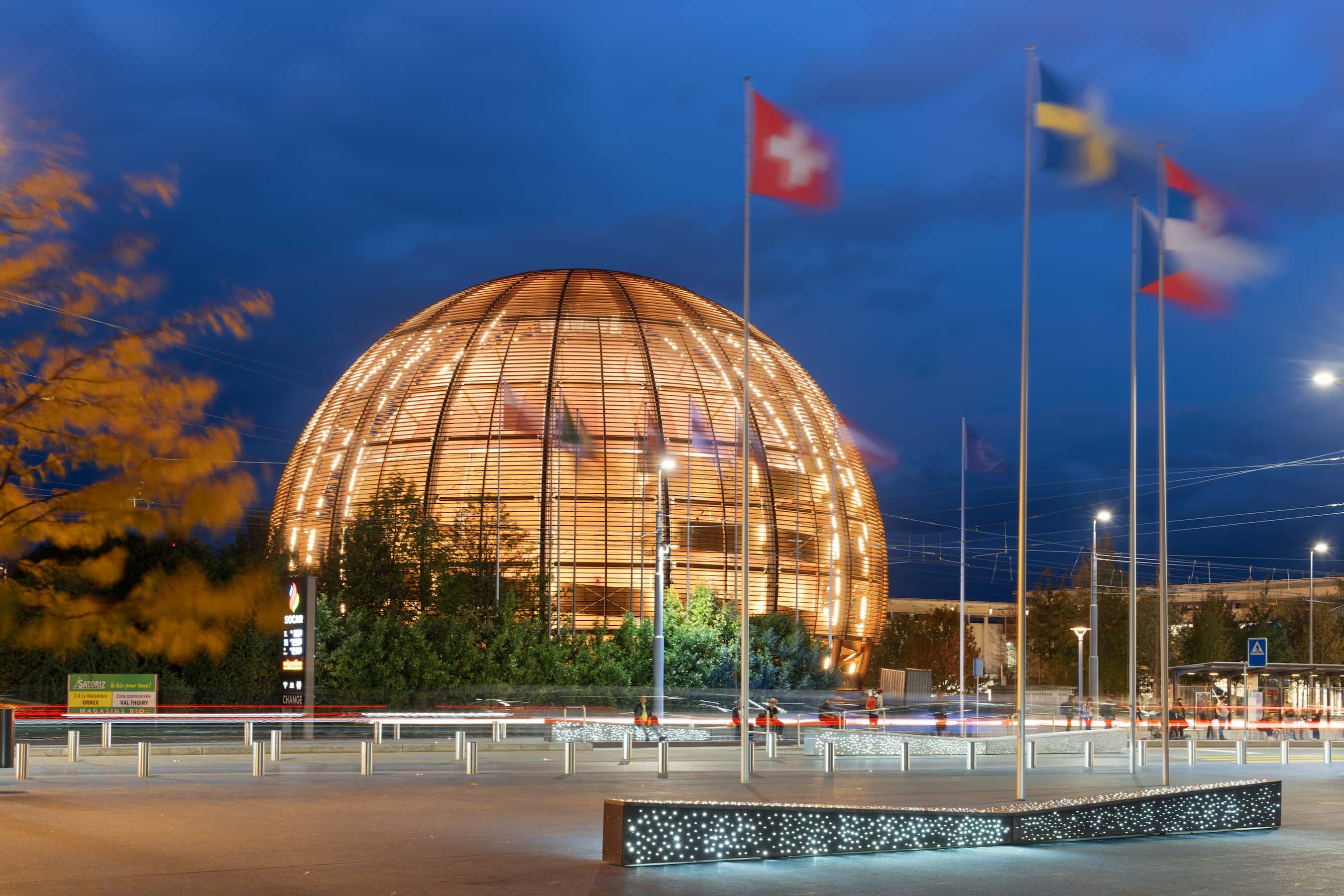
Dates: 30 June - 1 July 2026
Format: 2 half days + informal dinner
Meeting location:
CERN
Geneva, Switzerland
Esplanade des Particules 1
1217 Meyrin
1st day (30 June): 2nd day (1 July):
Meeting room: 3162/1-K01 Meeting room: 40/S2-A01
Location of meeting rooms can be found on CERN map: https://maps.cern.ch/
Getting there:
https://visit.cern/getting-here
Important to know - security & accessibility:
- Please bring a valid ID with you.
- On site, you will need to be accompanied by CERN staff and have your badge on you at all times.
Badges will be created based on registrations - please register on time.
Hotel recommendations:
https://sce-dep.web.cern.ch/housing/hotels-local-area
*We recommend booking a hotel on/nearby tram line 18 which connects you to central Geneva.
REGISTRATION LINK HERE
*On-site & online participation possible.
For any questions, please email nadelina.sandu@geant.org.
AGENDA
Tuesday, 30 June
| Time (CEST) | |
|---|---|
| 11:30 - 11:45 | Arrival & badge pick-up |
| 12:00 - 13:00 | Lunch |
| 13:00 - 13:15 | Welcome - Dom Vicinanza (GÉANT and Anglia Ruskin University), SIG-Quantum Coordinator Slides |
| 13:15 - 13:45 | Quantum technologies meet high energy physics challenges, Michele Grossi (CERN) Abstract: CERN with its Quantum Technology Initiative is looking into how this revolutionary technological change could align with CERN research and collaboration objectives. After a preliminary introduction about the promise of quantum technologies with a focus on computing, we will discuss main research directions and results from theoretical foundations of quantum algorithms to application in several areas of HEP. Slides |
| 14:00 - 15:00 | ATLAS control room tour |
| 15:00 - 15:15 | Coffee break |
| 15:15 - 15:45 | QUANT-NET: A Distributed Quantum Computing Testbed using photon-matter entanglement distribution over fiber-link, Inder Monga (ESNet) |
| 15:45 - 16:15 | Entanglement Networks for Datacentre-Scale Quantum Computing, Dr Mario de Miguel Ramos (Nu Quantum) Abstract: The quantum computing industry has been sustaining fast progress in scale-up, with quantum processors now demonstrating error-corrected logical qubits and first indications of computational advantage for narrow scientific problems. This talk will look ahead to what we require to reach full commercial advantage, and show that there is a key piece missing: modularity. The scaling path we envisage will entail building multi-core quantum computing clusters at the datacenter scale, and eventually connecting tens or hundreds of modules together to enable multi-million-qubit machines. This talk will describe our distributed quantum computing architecture underpinned by photonic interconnects. It will outline the technical challenges that need to be overcome to progress the technology, and how Nu Quantum is working to build the pieces needed to scale out towards useful quantum computation. |
| 16:15 - 16:30 | QKD and beyond QKD, Wojciech Kozlowski and Garazi Muguruza Lasa (SURF) |
| 16:30 - 16:45 | Hybrid Quantum-Classical computing infrastructure - algorithms and use cases, Piotr Rydlichowski (PCSS) Abstract: In this talk we will present current state of PCSS quantum computing infrastructure, systems, architecture, use cases and how it alligns with EuroHPC JU activities. Hybrid quantum-classical computing infrastructure, algorithms and use cases and critical step to advance quantum computing in utility scale era and move toward error-corrected systems. |
| 16:45 - 17:00 | Closing of 1st day |
| 18:30 | Group dinner at Pizzeria Restaurant de la Place/Cafe de la Place (self-paid) Address: Rte de Meyrin 286, 1217 Meyrin, Switzerland |
Wednesday, 1 July
| Time (CEST) | |
|---|---|
| 08:30 - 08:45 | Arrival |
| 09:00 - 09:15 | Welcome and introduction |
| 09:15 - 10:00 | Toward a Quantum-Safe AI Supercycle, Marta Buffa (NOKIA) and Nicolas Le Sauze (NOKIA Bell Labs)
|
| 10:00 - 10:30 | Distribution of polarization-entangled photon pairs co-existing with White Rabbit signals over shared optical fiber, Annick Teepe (CERN) |
| 10:30 - 11:00 | Coffee break |
| 11:00 - 11:30 | Quantum sensors: Technologies, Networks and Interfaces, Ksawery Mielczarek (PCSS) Abstract: In this talk, I will provide an overview of quantum sensing technologies, including atomic clocks, magnetometers, gravimeters and gyroscopes. I will introduce their operating principles, review the current state of the art, and discuss representative real-world applications. I will also examine whether these devices really offer a quantum advantage over their classical counterparts. |
| 11:30 - 12:00 | Meeting evaluation & closing comments |
| 12:00 - 13:00 | Lunch |