Status Legend:
MISSING No information has yet been collected.
INCOMPLETE All information has not yet been collected.
COMPLETE Information collection has been completed.
FINALISED The template has been finalised.
Result information | |
|---|---|
| Title of the Result (120 characters) | Updated AARC Blueprint architecture for emerging technologies and services in pan-European research infrastructures |
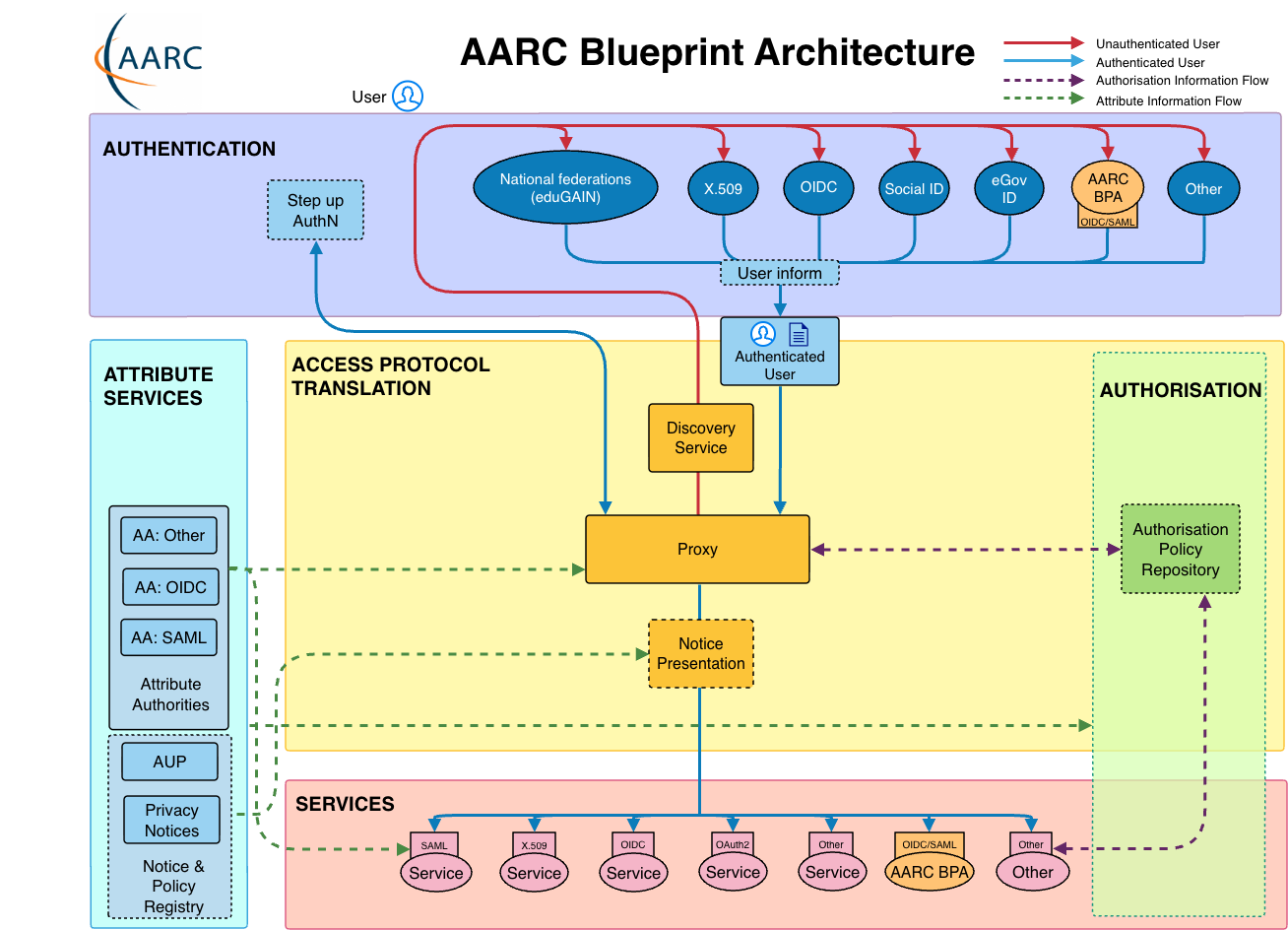
Message/Teaser to the potential user (1000 characters) | The AARC Blueprint Architecture (BPA) 2025 provides an updated reference architecture for federated Authentication and Authorisation Infrastructures (AAIs) supporting research collaborations. Building on previous AARC Blueprint releases, this update consolidates architectural concepts, components, and interaction patterns reflecting current practice in pan-European research infrastructures. The Blueprint Architecture describes a common architectural framework and terminology for designing and operating federated AAI solutions, with a focus on interoperability across organisational and technical boundaries. It does not prescribe specific implementations, but instead provides a technology-agnostic reference that can be adapted to different deployment models and environments. The AARC BPA 2025 is published as part of the AARC TREE project to support alignment, reuse, and a shared understanding of AAI architectures across research infrastructures. |
| Video/Image |
|
Result Type | Select one from the following list:
|
Target Audience | Select up to three from the following list:
|
Our needs are | Select up to three from the following list:
|
We specifically need/are looking for (600 words) | We are looking for additional adopters and implementers of the AARC Blueprint Architecture for international research collaboration. In particular, we welcome feedback from organisations designing or evolving federated AAI architectures and integrating services via AARC-aligned patterns. We are also interested in collaboration opportunities to validate the applicability of the BPA 2025 guidance in diverse operational contexts, and to collect implementation experience that can inform future revisions and community guidance. |
About us | |
Main project | AARC TREE |
Other related projects | Optional – won’t be visible in the entry |
Result Contributors | AARC TREE consortium |
Owners for exploitation | AARC Community |
Start-up created for further exploitation? | No |
Logo | N/A |
Testimonials | |
Title |
|
Link | |
Find us on | |
Description | The AARC Blueprint Architecture and related outputs are available through the AARC Community website and archived on Zenodo for long-term open access. |
Link | |
Result description and influence | |
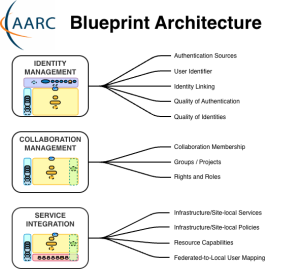
Result description (1200 characters) | The 2025 revision of the AARC Blueprint Architecture (AARC BPA) provides a reference architecture for federated Authentication and Authorisation Infrastructures (AAIs) supporting research collaborations. It introduces a refined functional capability-based model structured around Identity Management, Collaboration Management and Service Integration, clarifying functional responsibilities while preserving backward compatibility with previous AARC BPA versions. The revision strengthens interoperability across independent AAI deployments, supports modular implementation, and accommodates both community-first and identity-first user workflows. It also establishes a foundation for future credential paradigms, including verifiable credentials. The AARC BPA 2025 enables sustainable, interoperable federated access across European and international research infrastructures. The AARC BPA 2025 shows broad European and international alignment. Elements of its architectural model are reflected in the EOSC AAI Architecture 2025 and referenced within national and international identity federation initiatives, including IAM4NFDI and the Australian Access Federation (AAF). |
Business Sector(s)/Policy Area(s) | Select up to three from the following list:
|
Tags/Keywords |
|
Your result's contribution to Sustainable Development | |
Contribution to UN Sustainable Development Goals | Select up to three from the following list:
|
Radical Innovation Breakthrough? | No |
Are you a member of the 'World Alliance for 1000 Solutions'? | No |
Your result's influence on policy | |
Has your result had or do you expect it to have a significant influence on policy-making? | Yes |
Other information/data to share | |
Title (optional, one or more links to further information) |
|
Link | |
Result, Business Maturity and Exploitation Outlook | |
Result Maturity | 9 |
Current Stage and Next Steps | The result has reached a mature stage as a reference architecture with multiple operational deployments across research and e-infrastructures, enabling interoperable federated and cross-border access to distributed services and being maintained through active community governance. Future work focuses on its evolution towards support for identity wallets and verifiable credentials, further alignment with emerging trust frameworks such as OpenID Federation, and broader adoption beyond traditional research infrastructures |
Do you already have customers for this result? | Yes |
Number of existing customers | >1000 |
What type of customers/ users do you have? | Select all that are applicable:
|
Which Business Sectors do your customers mainly come from? | Select all that are applicable:
|
Unique value proposition | The AARC Blueprint Architecture provides a vendor-neutral, community-driven reference architecture that enables interoperable federated authentication and authorisation across organisational and national boundaries, reducing integration complexity for secure cross-infrastructure collaboration. |
Do you have a scalable business model? | The result follows an ecosystem-driven scalability model, where adoption grows through open standards, community governance, and independent implementations rather than centralised service provision. Organisations and infrastructures can replicate and deploy the architecture without having to re-invent the wheel, while interoperability benefits increase as more infrastructures align with the framework, enabling scalable impact without proportional operational overhead. |
Is your result replicable? | Yes |
Please elaborate on the Replicability | The AARC Blueprint Architecture is inherently replicable as a technology-agnostic reference architecture. Organisations can independently implement the defined Functional Capabilities (Identity Management, Collaboration Management, and Service Integration) using different software stacks while maintaining interoperability. The architecture does not depend on a specific vendor, platform, or deployment model, enabling reuse across national, European and international research infrastructures. Multiple independent implementations already demonstrate its replicability across diverse organisational and technical environments. |
Is your result and your business model sustainable in the long term? | Yes |
Please elaborate on Sustainability | The sustainability of the AARC Blueprint Architecture is ensured through community governance and broad ecosystem adoption rather than dependence on a single project or funding stream. The architecture is maintained by the AARC Community and aligned with major European initiatives (e.g. EOSC). Its vendor-neutral and modular design allows independent evolution of components while preserving interoperability. Backward compatibility with previous BPA versions protects existing deployments, reducing migration risk and ensuring long-term stability. Sustainability is further reinforced by adoption across national and international AAIs for research collaboration, creating a growing interoperable ecosystem that incentivises continued maintenance and evolution. |
Are you targeting geographical markets? | While initially developed within Europe, the AARC BPA supports global interoperability and cross-border research collaboration. |
Investor Corner | |
What level of investment (EUR) are you currently looking for? | Not applicable (0 EUR). The AARC Blueprint Architecture is a reference architecture, relying on open standards and community governance, rather than centralised commercial service provision. Future evolution is supported through collaborative project funding. |